Key Takeaways
- High-smoke-point oils are essential for seasoning carbon steel, while nonstick pans do best with a light coat of neutral oil.
- Olive oil should never be used for seasoning because its low smoke point creates a sticky, uneven residue.
- Coconut oil can season carbon steel but adds flavor and is less durable than grapeseed or avocado oil.
- Cooking sprays often damage nonstick coatings, so applying a small amount of oil by hand is safer.
- Proper oil use and mindful care extend the lifespan and performance of both carbon steel and nonstick pans.
The oil you choose for your cookware can make the difference between a pan that stands the test of time and one that wears out quickly. Carbon steel and nonstick pans are two of the most popular types of cookware. Both require very different care, but both benefit from the right oils and maintenance methods.
This article will cover why oil choice matters, why olive oil isn’t recommended, which oils are best for seasoning carbon steel, and whether cooking sprays belong on your nonstick pans.
Seasoning Carbon Steel: Why Does Oil Choice Matter?
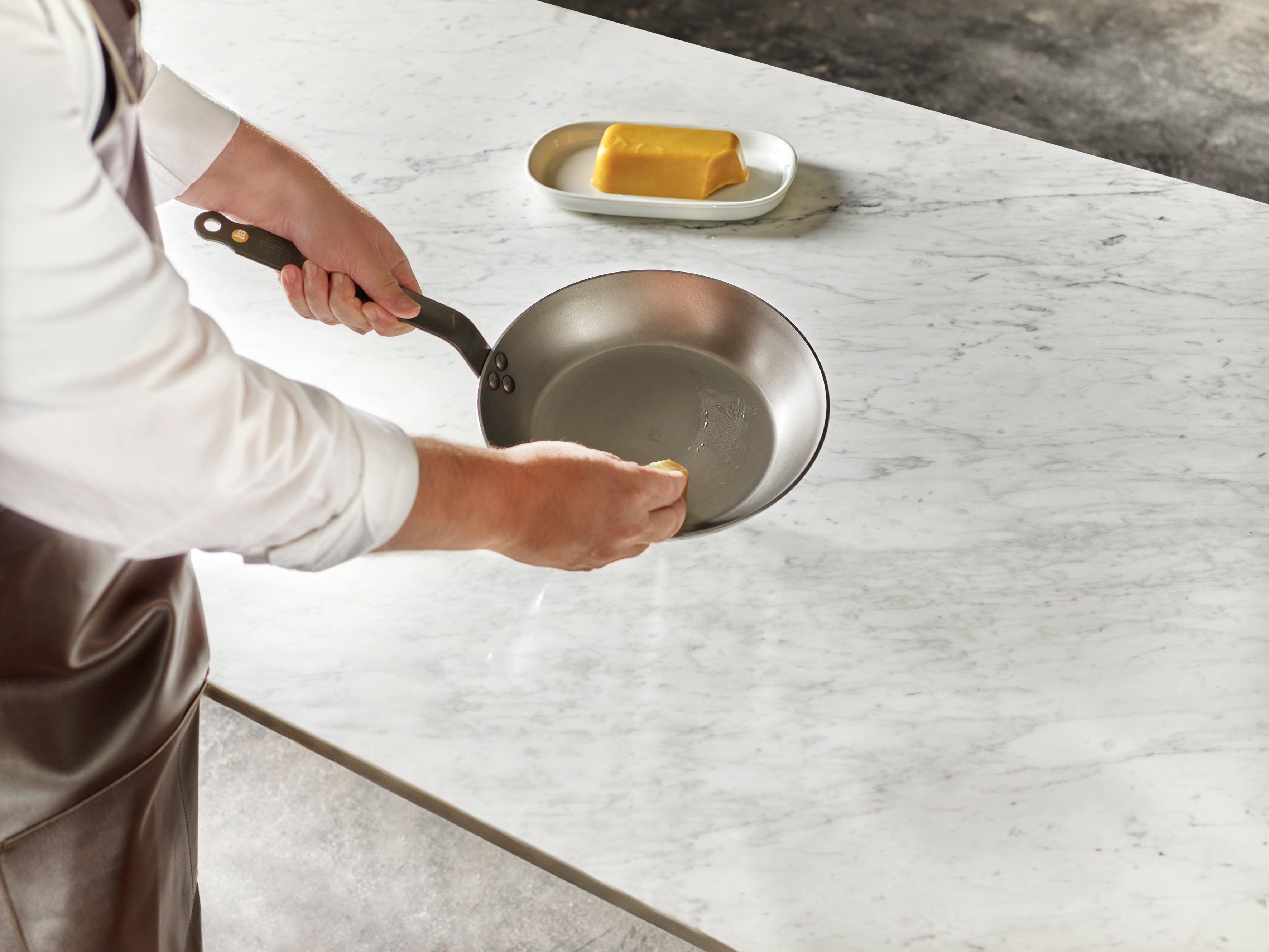
Here’s a quick refresher: seasoning is the process of creating a hardened layer of polymerized oil that protects the pan and makes it naturally nonstick. For a proper season, your chosen oil must withstand high heat without breaking down.
This means that oils with a high smoke point are required; low smoke point oils can burn, become sticky, or leave uneven residue. Not only does this ruin the seasoning process, but it creates another mess, requiring intense cleaning.
Olive Oil vs. Coconut Oil for Carbon Steel
Most cooks have olive and coconut oil lying around the kitchen. It may be tempting to reach for these commonly used oils when it’s time to season your pan. Before you do, you need to know what’s really going to benefit your carbon steel pan.
Why Olive Oil Isn’t the Right Choice
Olive oil has a low smoke point, typically 325–375°F, though this does vary depending on the type of olive oil. Extra virgin olive oil is at the low end, which makes it completely unsuitable for seasoning carbon steel.
If you mistakenly use olive oil for seasoning, you’ll get a sticky or uneven layer that doesn’t bond well to the pan and is difficult to remove. Olive oil is better reserved for cooking or finishing dishes, not for the seasoning process.
Coconut Oil for Seasoning Carbon Steel
Coconut oil has a higher smoke point than olive oil, but it is still not the ideal choice compared to neutral oils. The pros are that it’s easy to find in stores, adds a reasonably strong layer, and works in a pinch. The only issues are that it can impart a subtle flavor and is less durable than oils like grapeseed or sunflower.
Coconut oil can work, but it’s not the best option available. Instead, oils like grapeseed and avocado will give you a better result.
Shifting to Nonstick: A Different Set of Rules
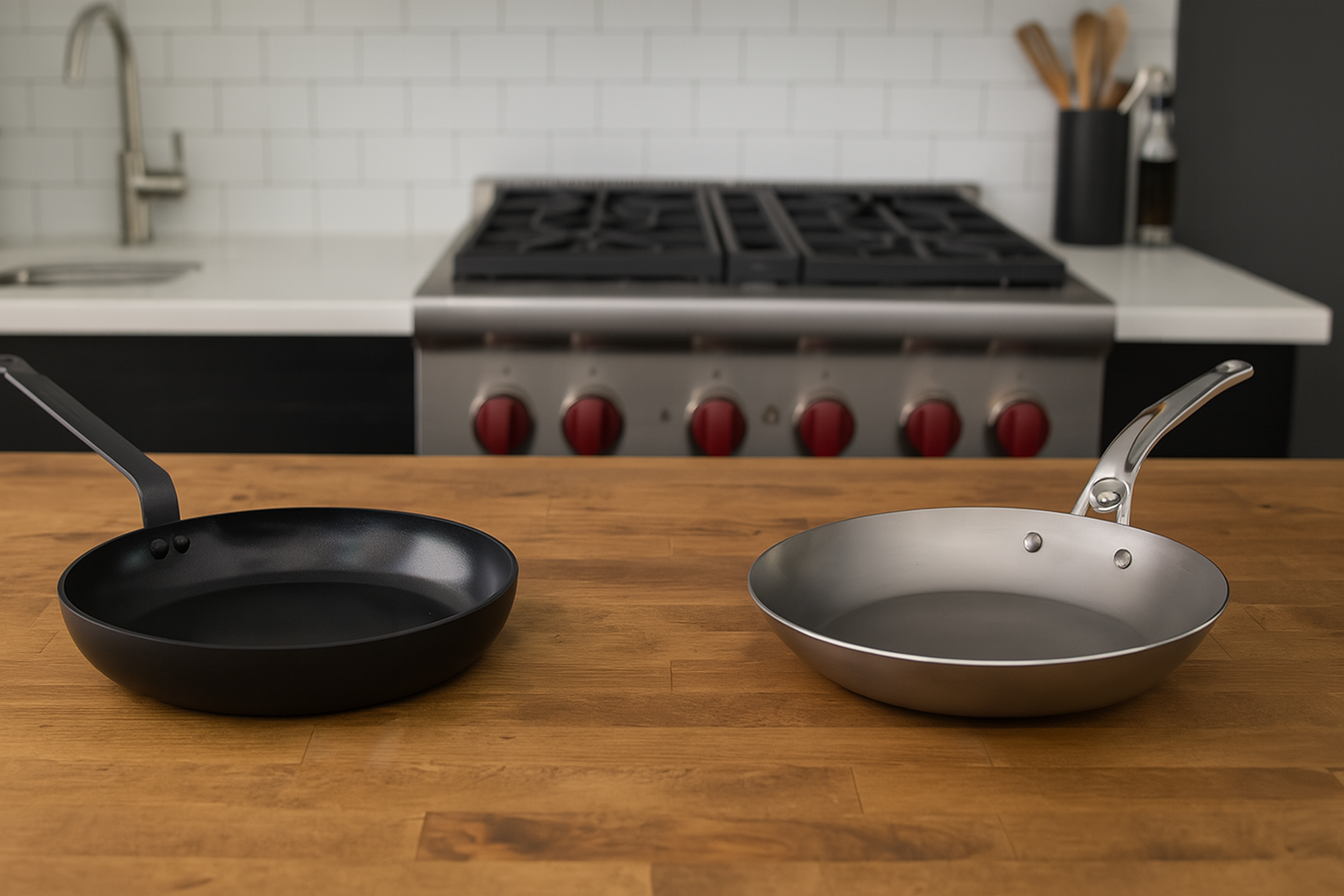
Unlike carbon steel, nonstick pans already have a protective surface, so “seasoning” isn’t necessary. The real question is what role do oils and sprays play in protecting—or damaging—nonstick coatings?
Should You Use Cooking Spray on Nonstick Pans?
The short answer is kind of. Cooking sprays can be extremely convenient and cheap. The issue is that many aerosol sprays contain additives, like lecithin or propellants, that are designed to keep the spray mixed and stabilized. These additives often leave sticky residues, degrading nonstick surfaces over time.
There are some sprays that don’t use additives, though they may be more expensive or just not spray as well. Instead of using spray, it’s better to use a small amount of regular oil (olive, canola, avocado) applied with a paper towel or brush. This is slightly less convenient than spray, but it is better for your pan in the long run.
Remember, occasional use won’t destroy your pan overnight, but consistent spray use shortens its life. Once your nonstick pan’s surface is affected in any way, it must be thrown away. This layer cannot be fixed or replaced.
How These Practices Connect
Carbon steel and nonstick couldn’t be more different, but both require mindful choices when it comes to oils.
- Carbon steel: the right oil builds strength and longevity.
- Nonstick: restraint with sprays preserves coating and performance.
- Shared takeaway: cookware lasts longer when treated with intention.
Treat Oils as Cooking Tools
Olive oil is not for seasoning, but coconut oil could work for seasoning carbon steel, though it’s not the best option. Cooking sprays, however, should generally be avoided on nonstick pans. Choosing the right oil and method preserves your cookware, enhances your cooking, and protects your investment.
Explore de Buyer’s collection of carbon steel and nonstick pans—crafted to perform and designed to last with proper care.



Recommended for You
-
MINERAL B PRO Carbon Steel Fry Pan
8"
9.5"
11"
12.5"
$110.00 - $175.00
Regular price $110.00Regular priceUnit price per$0.00Sale price $110.00 -
MINERAL B Classic Carbon Steel Fry Pan
8"
9.5"
10.25"
11"
12.5"
14"
$75.00 - $165.00
Regular price $75.00Regular priceUnit price per -
MINERAL B PRO Carbon Steel Omelette Pan
9.5"
11"
$130.00 - $145.00
Regular price $130.00Regular priceUnit price per -
Blue Carbon Steel Fry Pan
8"
9.5"
10.25"
11"
12.5"
$60.00 - $95.00
Regular price $60.00Regular priceUnit price per -
MINERAL B Carbon Steel Omelette Pan
8"
9.5"
11"
$85.00 - $120.00
Regular price $85.00Regular priceUnit price per -
 Sold out
Protective Sleeve for Pan Handle
Default Title
$12.50 - $12.50
Regular price $12.50Regular priceUnit price per -
MINERAL B Carbon Steel Crepe & Tortilla Pan
9.5"
10.25"
12"
$75.00 - $100.00
Regular price $75.00Regular priceUnit price per -
Blue Carbon Steel Crepe & Tortilla Pan
7"
8"
9.5"
$30.00 - $50.00
Regular price $30.00Regular priceUnit price per -
MINERAL B Carbon Steel Egg & Pancake Pan
4.75"
5.5"
$50.00 - $60.00
Regular price $50.00Regular priceUnit price per -
MINERAL B Carbon Steel Country Fry Pan
9.5"
11"
12.5"
$125.00 - $185.00
Regular price $125.00Regular priceUnit price per -
Blue Carbon Steel Baking Sheet
15.75" X 11.8"
23.6" X 15.75"
$45.00 - $55.00
Regular price $45.00Regular priceUnit price per -
B BOIS Crepe Spatula
Default Title
$10.00 - $10.00
Regular price $10.00Regular priceUnit price per